
Chapter 01 · Panels & Service Entrance
Service Mast Wire Securing: Code-Compliant, Inspected Right
Loose or unsupported service entrance wires fail inspection and put your home at real risk.
Free estimate
Tell us what you need
A short form. It reaches a person here, not a call centre.
What Proper Mast Wire Securing Actually Requires
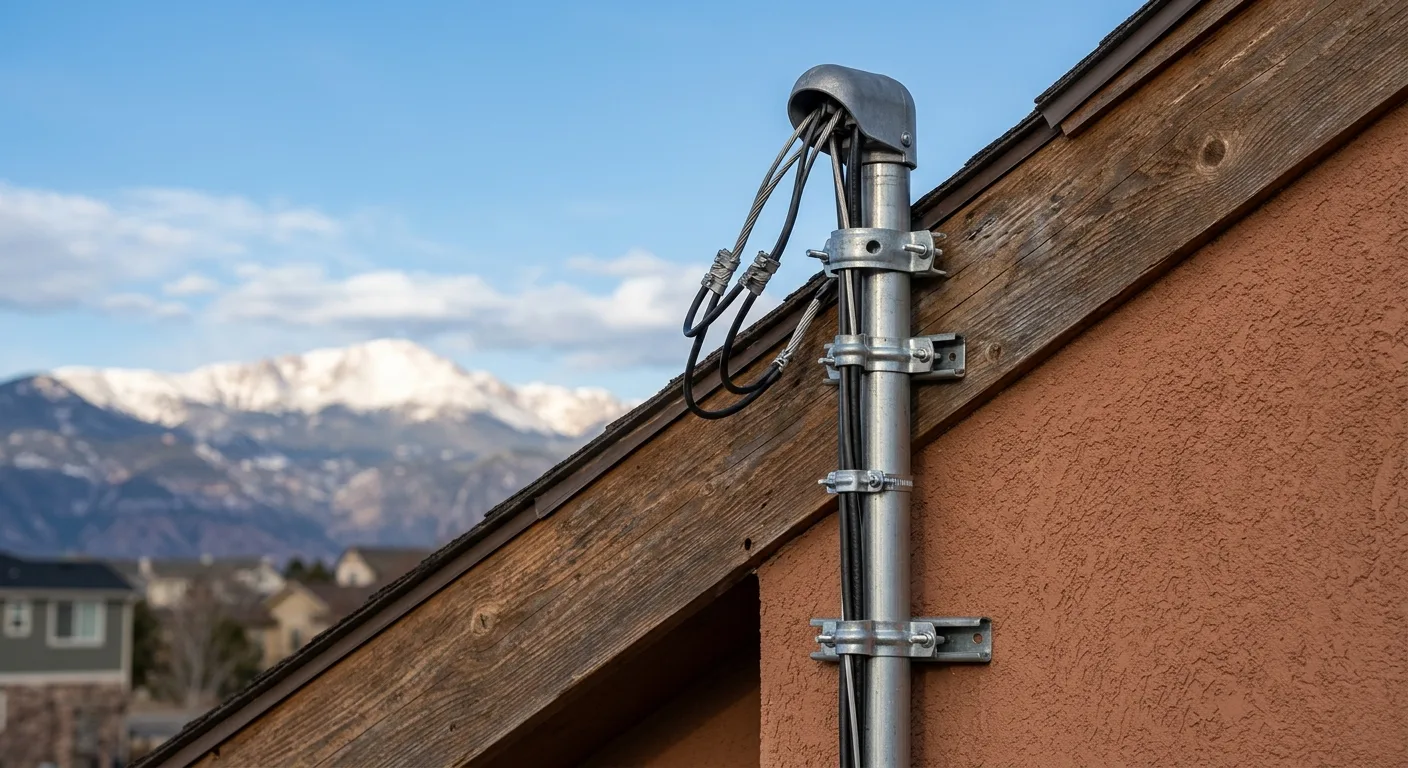
Service mast wire securing isn't a cosmetic fix. The NEC (National Electrical Code) requires that service entrance conductors be supported within 12 inches of the weatherhead and at intervals not exceeding 30 inches along the mast, and when those wires work loose, the insulation wears, the connection at the weatherhead degrades, and you've got a genuine hazard at the point where utility power enters your home. If you're seeing sagging drip loops, exposed conductors at the mast head, or wires pulling away from the exterior wall, that's not something to watch and wait on. Call All Electric at (720) 951-4619 and we'll assess it the same visit. Every repair comes with a 1-year labor warranty.
The scope of a service mast wire securing job depends on what's there: the mast material (PVC conduit, EMT, or rigid metal), how the conductors are currently fastened, whether the weatherhead itself is intact, and whether the utility's drip loop has enough clearance above the roofline to meet code. Some jobs are a fast re-strapping with approved cable staples or straps against solid framing. Others involve replacing a cracked PVC mast section, reseating the weatherhead, or coordinating with Xcel Energy for a brief service disconnect. We pull permits when they're required and handle the inspection. Every job is different, contact All Electric for an accurate estimate.
What the NEC Requires for Service Entrance Masts
These aren't suggestions. They're the minimum standards your home must meet to pass inspection.
Support within 12 inches of the weatherhead
NEC 230.54 requires that service entrance conductors be fastened to the structure within 12 inches of the service head. A wire left unsupported past that point is a code violation on the day of the next inspection.
Support intervals no greater than 30 inches
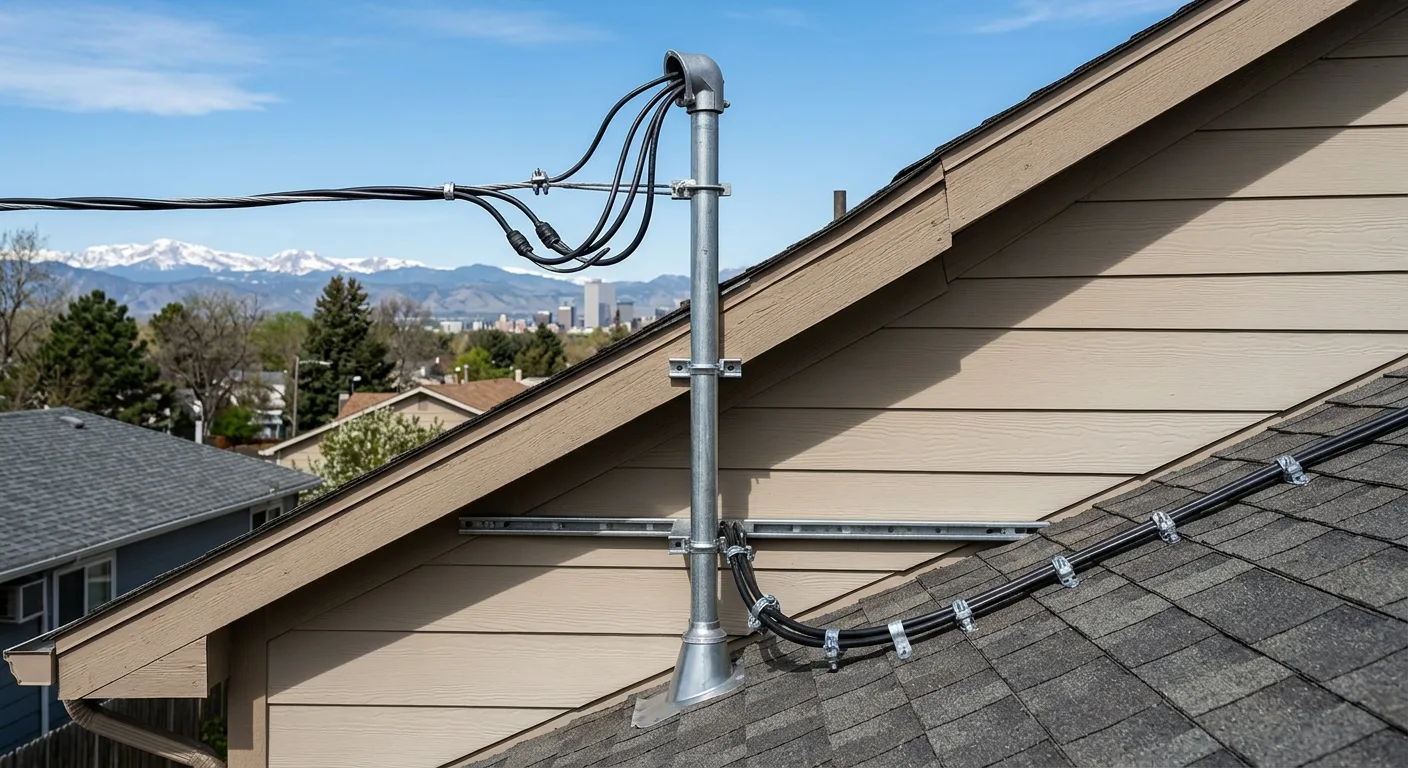
Along the full run of the mast, conductors must be secured at intervals not exceeding 30 inches. That's measured along the surface of the building, not the wire itself. Most older installs that fail inspection are failing here.
Weatherhead positioned above the point of attachment
The weatherhead must face upward or toward the wall at an angle that prevents rain entry. A weatherhead that's cracked, rotated, or pulling away from the mast doesn't meet this standard regardless of wire condition.
Drip loop with minimum 10-foot clearance above grade
The drip loop, the downward curve of the service wires before they enter the weatherhead, must hang low enough for rain to drip off before reaching the weatherhead, and must maintain at least 10 feet of clearance above any surface below.
Common Failures
Signs Your Service Mast Wires Need Attention Now
Wires Pulling Away from the Exterior Wall
When the strap or staple holding conductors against the siding fails, the wire run goes slack. That transfers mechanical stress to the weatherhead connection, the exact point where utility power enters your panel.
Cracked or Deteriorating PVC Conduit
PVC mast conduit exposed to UV and temperature cycles develops micro-cracks over time. A cracked mast can't hold straps at the right tension, and water intrusion into the conduit accelerates conductor insulation breakdown.
Sagging Drip Loop
A drip loop that's dropped below the weatherhead entry point no longer sheds water away from the conductors. Moisture enters the weatherhead, corrodes the conductor ends, and eventually compromises the connection inside your meter base.
Failed Inspection Flag
If a home inspector or the utility flagged your service entrance wiring as unsupported or improperly secured, that notation follows the property. It needs a licensed electrician to correct and document before your next closing or renewal.
How We Work
From Assessment to Permit Sign-Off
-
Step 1: Inspect the Full Service Entrance
We look at the weatherhead, mast, conductor insulation, existing straps or staples, and the point of attachment to the structure. What we find determines the scope of work, and we'll explain all of it before anything gets touched.
-
Step 2: Secure, Replace, or Reconfigure
If the mast is structurally sound, we re-strap the conductors to NEC spacing. If the conduit is cracked or the weatherhead is compromised, we replace the section, reseat the head, and restore a proper drip loop. We use approved hardware, not zip ties, not improvised fasteners.
-
Step 3: Permit and Inspection Where Required
Service entrance work often requires a permit and a utility notification. We handle both. After the work, we schedule the inspection and you get documentation you can hand to an insurance adjuster or a future buyer.
Materials Matter More Than Most Homeowners Realize
Why homeowners trust us
What Sets a Showpiece Install Apart from a Patch Job
A properly secured service mast is one you don't think about again for decades. Here's what that looks like on paper.
-
CO License #ME.0600978
Every service entrance job requires a licensed contractor. Not a handyman, not a general contractor.
Verify with the state -
1-Year Labor Warranty
If a strap fails or a fitting works loose within a year of our work, we come back and fix it.
-
Fully insured
Service entrance work involves live utility conductors. You need a contractor who carries real insurance on that exposure.
Service Mast Wire Securing: Common Questions
Not answered here? Call (720) 951-4619 and ask the electrician.
What is the NEC code for service mast wire support intervals?
Can a homeowner secure service mast wires themselves, or does it require a licensed electrician?
Can EMT be used for a residential service mast?
What happens if the utility flags my service mast as non-compliant?
My service wires are attached to a weatherhead but the straps are missing: is that a code violation?
How do I know if my mast needs full replacement versus just re-strapping?
Your Service Entrance Wires Need a Licensed Eye
468 Google reviews. 9 years in the trade. One license number you can verify.